Commentary - History - Photos- Politics - Religion - Travel Logs

Showing posts with label Travel to Syria. Show all posts

Tuesday, July 31, 2007

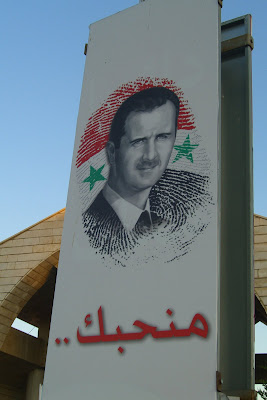
Bashar Asad, Syria's Chuck Norris, Arnold Schwarzenegger & Joseph Stalin Rolled Into One: A Photo Essay

A Beautiful 1959 Cadillac Eldarodo in Damascus, on the back there was a poster of Bashar Asad.

The glorious hero/leader of pan-Arabism: Bashar Asad!...Can't you see the little sparkles around him? I guess that means he's Syria's gift from God...

Coming soon to a WalMart near you: BASHAR ASAD: THE T-SHIRT!

Globalization at its best...CocaCola, blacklisted by the Arab League because it sells to Israel, is sold in Syria...Well, I guess even a Coke stand which sells to the "evil Zionist/Imperialist/Satanic" Israel loving beverage needs a Bashar poster---Irony at its best...

In the words of the Library of Congress, Syria - Concepts of Nationalism, Unity, and the Arab Nation, "The Syrian Socialist Nationalist Party (SSNP), which is banned in Syria", is shown here on this poster (which dotted Damascus' Old City) with Bashar Asad...Let me just get this straight...Asad has banned the SSNP in Syria, yet, in turn the SSNP has remained Asad's loyal ally in Lebanon. To top that off, in a 1984 style police state that controls everything, there are posters with him and the SSNP all over. Where is the disconnect?

© All Rights Reserved; www.ArzelJabal.blogspot.com

Saturday, July 28, 2007

Palmyra: Camels, Columns, & Geography


Palmyra, was the ancient Roman caravan city where camels, horses, and thousands of people rode through to get on the Silk Road to China. The city itself was incredibly well preserved, with columns and buildings were left as they were two thousand years ago. I had a nice time in Palmyra. The weather was simply beautiful. The wind combined with dry desert heat, particles of sand blew in the air. The night was so clear you could see every star perfectly, the moon shone like a silver dollar.

The hotel we stayed in, Zenobia's, was named after the beautiful Palmyran queen who, like the English Boudicca, stood up to Roman domination. Palmyra and the empire it controlled encompassed an area that spread from present day southern Turkey to modern Egypt. As with other short lived Roman era empires, it arouse from chaos within Rome, only lasting about 13 years. The ancient city of Palmyra now lies in ruins today because it was eventually crushed by the reorganized Romans.

Our tour guide was a sprightly Palmyran who loved to crack jokes about the Mukhabarat, Asad and Syria in general. Under normal circumstances this could land him in a lot of trouble, but I am guessing that with a load of Westerners he could get away with it. Even though he led on that he disliked Asad, he still subscribed to pan-Arabist and pan-Syrian propaganda. From claiming that much of the eastern Roman Empire was built on the backs of Arabs, to the claim that, at one point, the regions of Palestine (including Israel, the PA and Jordan), southern Turkey, and Lebanon were all part of Syria.

On the road to Palmyra we came upon a map of Syria that included the Turkish province of Hatay. Hatay, a region that used to belong to Syria (then under a French mandate), was given to the Turks by France following a popular referendum. The deal was also made to keep Turkey from joining the Axis power, and was unrecognized by Syria. In Hatay there were and are sizable Turkish and Arab communities. The district also contained the cities of Antioch (very important to Christians) and Alexandretta, the latter was considered Aleppo's port.

Here in the Levant, maps are incredibly important to the understanding of history, economics, and the people that inhabit the region. In Syria main inland cities such as Damascus, Aleppo, Hama and Homs all have connecting ports (see the map I've created and attached). One could draw an almost straight diagonal line from Syrian cities to their "natural ports." Currently, Syria's economy is stagnant, most goods have to come through the port of Latakiya, which is both far from the inland cities, and most definitely not a "natural port" to any Syrian city. Almost all of Syria's "natural ports" are in foreign states, its interesting to note that with almost all of these countries that hold ports that support Syrian cities, Syria has either tried to occupy them (take Lebanon for instance) or has ratcheted up pressure using terrorism (such as using the Kurdish PKK against Turkey).

At night I decided to wonder around Palmyra. The hotel was literally on top of the ruins, the night was very nice and I needed some time to suck in all of the history. The ionic and Corinthian columns shone in the moonlight as I walked through the desert scrub. I soon ran into a fellow student at LAU who was also taking in the history of the area. We decided to have an impromptu chat and walked all the way down to the central avenue in ancient Palmyra. Motor bikes went by us, about 2 every 10 minutes. I assumed the Bedouins were sizing us up, in the words of the LAU director, "they want money, they are all cheaters." Out of the blackness a Bedouin in full dish dash (the native white robe) and red and white kaffiah showed up on his camel offering us a ride. My classmate was hesitant at first, so was I, being in no mood to pay for anything that night.

Nevertheless, the Bedouin in true business fashion, decided that it was best to give us both free camel rides back to the hotel (a distance of about a mile), he felt that we could pass his card along to our tour guide. I learned later the man was the winner of the Qatar Camel Race, where he won €100,000 and a new Toyota Land Cruiser from the Shiek of Qatar. Incidentally I was riding the prized, winning camel that brought him all of this wealth and prestige. In the words of Goldie Hawn while on camel back in the film Protocol, "I [was] experiencing the new sights and smells."

After the camel ride under the stars, I danced the dabke and had an interesting meal of vegetables and half cooked meats (which later gave me that wonderful case of food poisoning), interrupted by skinny begging feral cats. The next morning we walked around the ruins, saw the amphitheater and the giant temples. In the amphitheater the Syrian Mukhabarat showed their heads. Some were in black dress pants and a button up white shirt, others wore jeans and baseball caps. They all had one thing in mind: watch the group of Americans. Their techniques of intelligence gathering were basic at best, one of them was "taking pictures of his friends" (aka more Mukhabarat). Holding a 1980s era large commercial plastic camera and wearing ill-fitting dress clothes, then started to snap pictures of the group, and was right behind us no matter where we went.

The Mukhabarat is strong in Palmyra, operating the infamous Tadmour Prison. Tadmour, the Arabic name for Palmyra, was the site of mass executions of the members of the Muslim Brotherhood in the 1980s. Even today the prison contains thousands of political prisoners.

Palmyra also served as an example regarding water security. In Roman times the city supported a population of 200,000, now the town of Palmyra (Tadmour) has but a few thousand. The region was much wetter and underground wells supported much of the population. With huge population growth in the Middle East over the past years, the wells have started to run dry. The same desertification and lack of water resources could effect the Levant over the next few years. The logical result would only be increased conflict and population displacement.

Syria and Lebanon have a fond place in my heart, but will be violent because of religion, resources, economic reasons, or tribal difficulties. The ruins of Palmyra truly show how the people here always want to be independent, will always be short of resources and how that urning for independence is fleeting. Even in the ancient world the Levant was known for its violence. Its more than fitting for the goddess Anat, lordess of the Levant used to hold and wear the hands and heads of those she killed.

Anat's soul was exuberant,
as she plunged knee-deep in the soldiers' blood,
up to her thighs in the warriors' gore …

Taken from Coogan, Michael D., translator, 1978. Stories from Ancient Canaan. Louisville, KY: Westminster

© All Rights Reserved; www.ArzelJabal.blogspot.com

Thursday, July 26, 2007

Misspellings of Syria


© All Rights Reserved; www.ArzelJabal.blogspot.com

Wednesday, July 25, 2007

Damascus Day Trip

The Friday night when we arrived in Damascus seemed to be jumping with excitement. There were throngs of people out; I noticed a preponderance of women wearing the hijab and long clothing. This was much unlike Beirut where even religious Shi'ite Muslim supporters of Hizbollah wear skin tight clothing. Damascus definitely had a mark of "Orthodox Sunnis."

Syria's population is between 70 and 80% Sunni Muslim, but they are ruled by the minority Alawite group who constitute no more than 11% of Syria's population. Many Sunnis, especially those in al Ikhwan (aka the Muslim Brotherhood) consider the Alawites to be heretical, regardless the Shi'ite clerics have accepted the Alawites as Shi'ite Muslims following Musa al Sadr's endorsement of the group in the 1980s.

We pulled into our hotel and were assigned room keys. My room was clean, but I heard other Americans had toilets missing seats or sinks that didn't work. I stored my insulin in the mini bar which looked a bit like a regularly used fridge in a frat house, bottled water, some chocolate, and some old unrecognizable food items were left around. In the lobby the waiters served "orange juice," or what we would call in the United States as "year old tang."

The group then went out to a meal in the Christian portion of the Old City of Damascus. The restaurant (as many other classical buildings in Damascus) was a mixture of black basalt stone and limestone or marble. There was a man playing Fairuz's Baalbek near a small fountain. I partook in Syrian beer, which felt like bitter corn syrup running down my throat and some native mezze (appetizers).

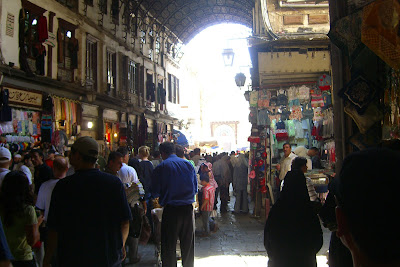
The next day we toured around the Old City. I acquired a painting of Damascus, a Damascene dagger, and a few other trinkets. I was especially interested in the Ummayad Mosque, built in the 700s over a destroyed church. The mosque was extraordinarily ornate. The floors were polished marble, there were columns with basalt and incredible Byzantine style mosaics. Inside the mosque there was the head of John the Baptist, and some body part belonging to Ali (the revered Mahdi or the Shi'ites).

The amount of Shi'ite Iranians was incredible in the area. It was easy to tell Damascus had great relations with Tehran just by the tourist traffic. There must have been six different groups containing Ayatollah Khomeniesque looking men. In the Damascus souk I heard more Persian than Arabic!

I also talked to an Armenian salesman by the name of Dikran. I asked Dikran if I could have one of his Bashar Asad posters (how many times in your life can you take a dictator who runs the Middle East's version of 1984 home with you?!), he suggested I go to the Baath party headquarters, and then wanted to talk to me about moving to Boston. Regarding the Asad posters, in Syria, they seemed as if they were a forced "product placement." In Beirut there was an actual outcry following Hariri's or Pierre Gemayel's assassination, as such people from the respective sectarian groups put up posters. However, in Syria (at the time Syria just had its "election." Bashar Asad won 97% of the vote), the posters were almost mandatory.

The other thing I noticed in Syria was the large amount of Hizbollah flags (I counted about eight in the old city), carvings of Hassan Nasrallah (Hizbollah's leader), even hand made leather trinkets featuring the aforementioned face were on sale. Under Hafiz Asad, Bashar's dad, Hizbollah was nothing more than a proxy militia, now it is a force to itself, and one force that is giving Bashar credibility. It seems as though the latest "Hizbollah victory" against Israel is also being accepted by Syria. At the very least Bashar Asad is standing side by side with Nasrallah and taking some of the limelight.


A video I made of Damascus's Ummayad Mosque.


Video I made of Damascus from a hillside near Asad's Presidential Mansion.

© All Rights Reserved; www.ArzelJabal.blogspot.com

Tuesday, July 24, 2007

Lines In the Sand

Taxis, tour buses, and private cars are lined up and not moving. Nevertheless, the border between Lebanon and Syria is full of hustle and bustle. Money changers, beggars, and to quote Cher, "tramps and thieves," are all around. Cars and SUVs coated in Arabian sand trickle through the crossing after coming from Bahrain, Saudi Arabia, Kuwait and other oil producing Gulf states.

After getting the passport stamped (along with twenty five other Westerners in my group) we waited for about two hours until the bus would be allowed through. As the bus passed under the border post there was nothing but concrete, past the border post were the dun colored hills of Syria.

The Syrian side of the border is quite an ironic place. First, there must be about one thousand pictures of Bashar Asad dotting the road, but then there is a duty free shop, complete with a Dunkin Donuts. What a great mix of consumerism, globalization, and the police state.

The duty free shop in itself was a study on the haves and have nots in Syria and Lebanon. The duty free was loaded with everything from Swiss chocolate, Cuban cigars, lego toys, and lots of liquor. Rich Lebanese business people and/or their sons would go to the place to buy $700 cellphones and $450 digital cameras. Syrians who went to the duty free were mostly army officers. The corruption in Syria is such, that those in the army, especially higher ranking officials are the only ones with cash to spend.

Also in the duty free, I got my first experience with the Syrian secret police, or, Mukhabarat. No matter where you went in the duty free, which was apparently owned by a Lebanese, there would always be a Syrian dressed in military fatigues or in dress pants following you. I went to take a shot of insulin in the bathroom and magically the "janitor" shows up to mop, only, he didn't mop, he just stood there near my bathroom door. When I exited he put the mop away and disappeared.

On the road to Damascus there were a few villages, and tons of Bashar Asad photographs. Everything in Syria was "cleaner" than in Lebanon. Garbage didn't usually line the streets, in Damascus there were many people out and about, traffic lights and traffic laws were obeyed. One of my fellow students asked me, "why are they obeying traffic lights like this?!" We were used to Lebanon where there are no traffic lights and one can drive while drinking a beer. My answer was, "what do you expect people to do if they knew their government wiped out a city and killed 20,000 people."

My answer really seemed to be the mood in Syria. The government was quite powerful. From the gaze of Bashar Asad's posters to the piles of Mukhabarat (I heard one Lebanese I was with say they were 1 in 5 of the Syrian population), Syria was firmly in the control of the al Asad clan.


My video of the Lebanese/Syrian border.

© All Rights Reserved; www.ArzelJabal.blogspot.com

Damascus Food Poisoning

Just to alert the readers, I got a wonderful case of food poisoning in Syria. I have been somewhat dellusional/throwing up/so tired I can't even move. I will post my photos and stories when I am feeling a bit more up to it.

Friday, July 20, 2007

Off To Syria

Through the grapevine I've been hearing that whenever fun American tour groups (especially with LAU) go off to Syria, we come complete with our own Mukhabarat (secret police) to follow us around. I am not going to let this stop me, so I have a few places lined up to see (mostly tourist sites), but I will attempt to go and talk to some of the people. We are leaving early tomorrow morning (at 8ish).

Wish me luck

Thursday, June 21, 2007

Off To Lebanon Part 2

In my previous post I talked about my upcoming trip. So, tonight I am off to Lebanon, it should be an interesting trip through JFK, Heathrow and finally Beirut Airport. I am traveling light with some clothing, Arabic books (for my classes in Beirut), a notebook, and a camera.

I will do my best to blog from Lebanon.

Topics I hope to cover:
  1. Hizbollah anti-government protests in Beirut.
  2. March 14th officials and their reaction(s) to the current assassinations by Syria.
  3. The Lebanese Army vs. Fatah al Islam in Tripoli.
  4. Rise of Khomenist Shi'ism/Iranian influence in Syria and Lebanon.
  5. Sectarian differences in Lebanon.
  6. Interviews with common people in Lebanon and their views on the current situation.

Sunday, June 17, 2007

To Lebanon

To all readers, I am off to Lebanon by the end of this week to attend an Arabic course and if possible get a few interviews for this fledgling blog. I will primarily be in the Beirut area but will most likely go off on adventures to Damascus and other parts of Lebanon. I hope to post some photographs when I get back.

Note: Any interviews I do get will be published on this site effective when I get back in the beginning of August. If I'm involved in any breaking news I will do my best to post it up here.

Wish me luck!